

Water in rock may complicate underground hydrogen storage
CSIRO-led experiments show that water inside tiny rock pores can trigger abrupt gas mixing, challenging assumptions used to model underground hydrogen storage.
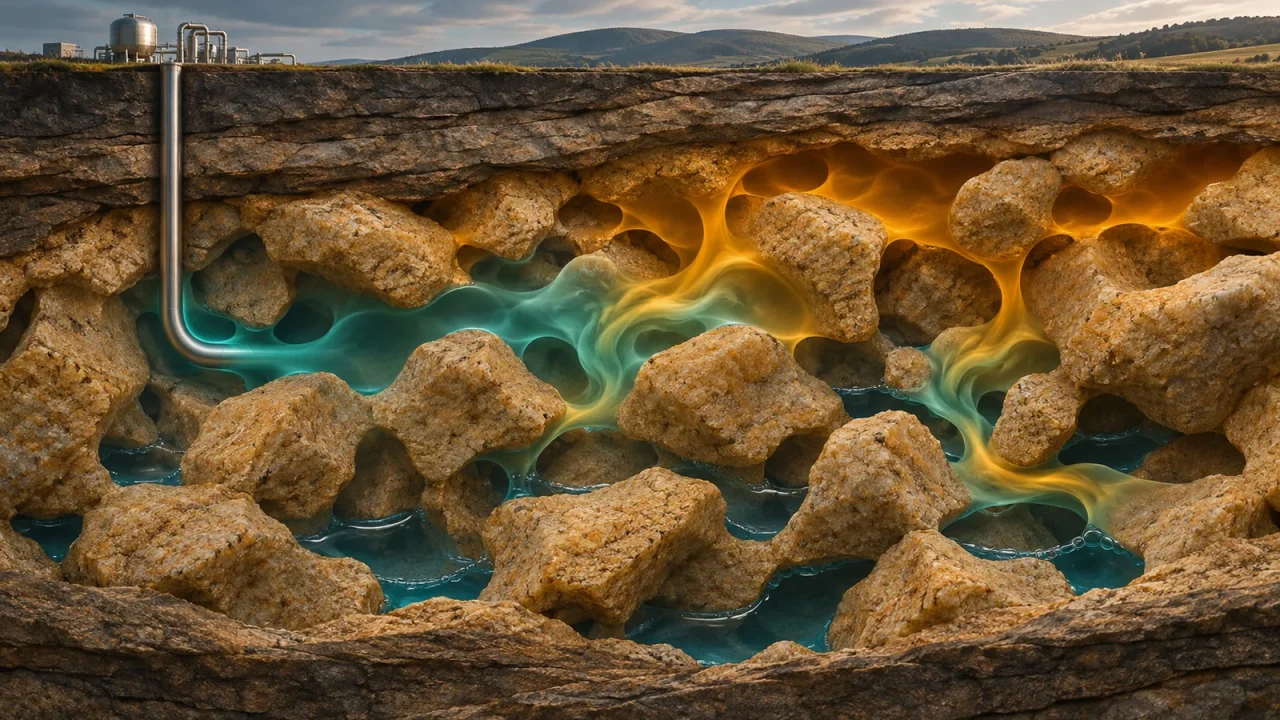
Water trapped inside microscopic rock pores may have a much larger influence on underground hydrogen storage than conventional models assume, according to new peer-reviewed research led by CSIRO.
The study does not demonstrate a working underground hydrogen store. Instead, it identifies a pore-scale process that could affect how accurately engineers predict the purity and recoverability of hydrogen injected into depleted gas fields or other porous formations.
What the researchers observed
The team used four-dimensional X-ray imaging to watch nitrogen enter a six-millimetre sandstone sample containing krypton gas and water. The two gases were selected because their different X-ray signatures allowed their movement and composition to be tracked through pores roughly the width of a human hair.
Rather than mixing smoothly, the gases initially occupied neighbouring pores separated by water. As the gas network became more connected, sudden rearrangements of gas and liquid opened pathways between those pockets and produced rapid bursts of mixing.
The researchers also directly observed a slower process in which isolated gas pockets exchanged material through the surrounding water. The paper describes this as multicomponent Ostwald ripening.
Why existing models may need revision
Large reservoir models commonly represent gas mixing through averaged properties such as effective diffusivity. The open-access paper in the Proceedings of the National Academy of Sciences concludes that this treatment can miss intermittent pore-scale behaviour and, in some circumstances, produce large errors in the estimated mixing rate.
That matters because hydrogen may mix with residual natural gas or another cushion gas after injection. The composition of the gas recovered from storage affects how much useful hydrogen can be extracted and what treatment it may require.
Why this matters in Australia
The research grew out of CSIRO work connected to H2RESTORE, which is assessing underground hydrogen storage in Victoria’s Otway region. CSIRO says Australia’s National Electricity Market could require substantially more storage as renewable generation expands, with underground hydrogen being considered as one possible long-duration option.
The findings provide a better foundation for modelling, but the next task is to translate behaviour seen in a tiny laboratory sample into reservoir-scale predictions. That step is essential before drawing conclusions about technical performance or project economics.
Hydrogen production also remains a separate challenge. An Australian waste-heat electrolyser project is moving toward a larger industrial trial, but neither project should be treated as evidence that large-scale hydrogen storage or production is commercially proven.
What the study does not show
This was a controlled laboratory experiment using nitrogen and krypton as stand-ins for gases relevant to storage. It was not a field trial, and it does not quantify the performance of a full underground hydrogen reservoir. The evidence supports revising the underlying physics in models; it does not establish that a particular Australian storage project will succeed or fail.
Primary sources