

Australian waste-heat electrolyser wins $15m backing
ARENA will provide $15 million toward a larger Victorian trial of Hadean Energy’s CSIRO-developed solid-oxide electrolyser for industrial hydrogen production.
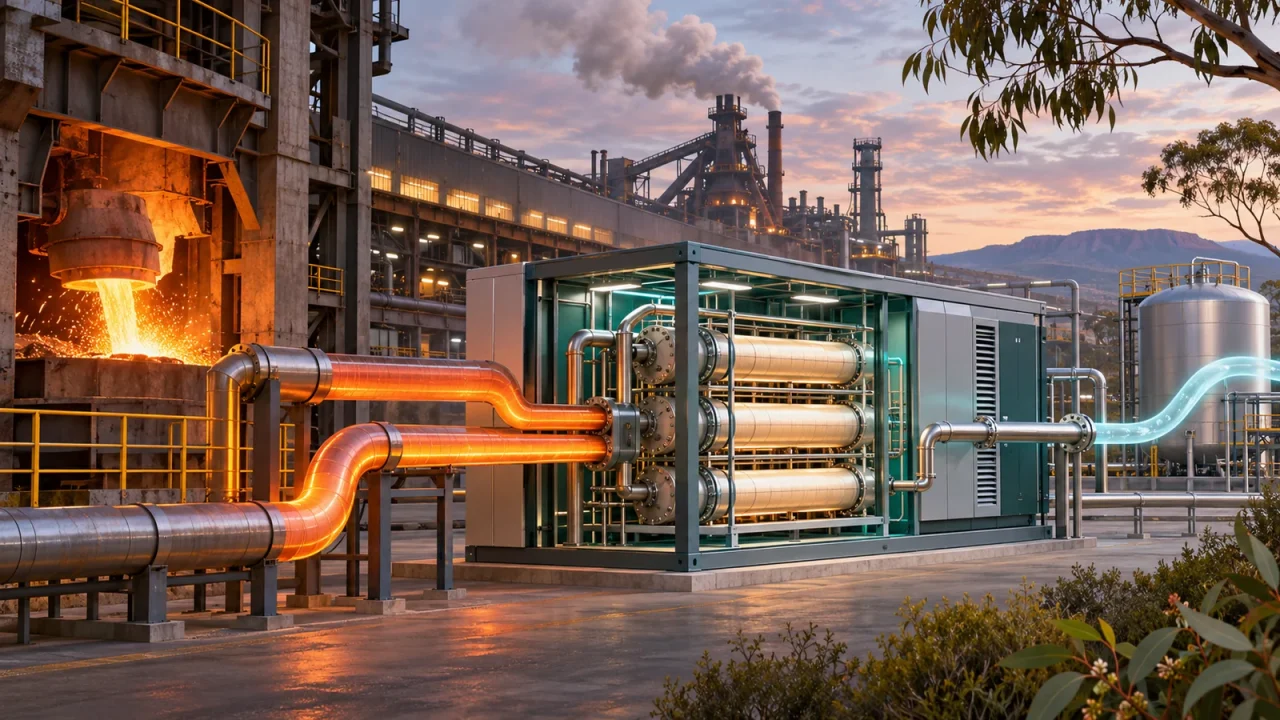
An Australian-developed electrolyser that uses industrial waste heat to reduce electricity demand is moving toward its largest demonstration yet, with the Australian Renewable Energy Agency committing $15 million to the project.
The funding is significant, but it is not a commercial result. The proposed Victorian pilot remains subject to final deployment arrangements and approvals, and its performance at the larger scale has yet to be demonstrated.
What ARENA is funding
ARENA says it will contribute $15 million toward a $30 million project led by Melbourne-based Hadean Energy. The company plans to build and operate a pilot tubular solid-oxide electrolyser and supply hydrogen for an annealing process at a separate steel manufacturing facility.
The planned system is expected to produce up to seven kilograms of hydrogen per hour and meet about 85 per cent of the annealing process’s hydrogen requirement. CSIRO describes the next unit as a 200–300 kilowatt industrial demonstration intended to advance the technology from technology-readiness level six toward level nine.
Why waste heat changes the equation
Electrolysers split water to produce hydrogen. High-temperature solid-oxide systems can obtain part of the required energy from steam or heat already available at an industrial site, reducing the amount that must come from electricity.
Hadean’s tubular design was developed by CSIRO over roughly eight years. The organisations say it can use around 30 per cent less electricity than conventional electrolysers when suitable heat is available.
CSIRO also reports that an earlier 1,000-hour pilot at BlueScope’s Port Kembla steelworks produced hydrogen using less than 36 kilowatt-hours of electricity per kilogram, compared with roughly 50–55 kilowatt-hours cited for other electrolyser technologies. Those figures come from the project partners and should be independently verified as the technology scales.
The industrial target
Hadean is aiming first at industries that already use hydrogen and generate usable heat, including steel, chemicals and fertiliser. That approach avoids waiting for entirely new hydrogen markets to appear.
The system can also be configured to produce synthesis gas from steam and carbon dioxide, according to CSIRO. Potential downstream uses include fuels and chemical production, but those applications are not outcomes of the newly funded project.
What happens next
The first phase covers engineering, design, manufacturing development, procurement, safety work and preparation for installation. Construction, commissioning and operation would follow. Hadean has also indicated that it expects to raise more capital for the construction phase.
For Australia, the test will be whether the lower electricity use survives the jump to a larger industrial system while meeting reliability, maintenance and manufacturing requirements. Funding enables that evidence to be collected; it does not supply the answer in advance.
The storage side of the hydrogen system has its own unresolved physics. Separate CSIRO-led research into gas mixing inside porous rock shows why production and storage claims need to be assessed independently.
Primary sources