

CSIRO method independently confirms the M87 black-hole ring
A small CSIRO team used a calibration-resistant imaging method to independently recover the ring around M87*, strengthening confidence in the landmark black-hole image.
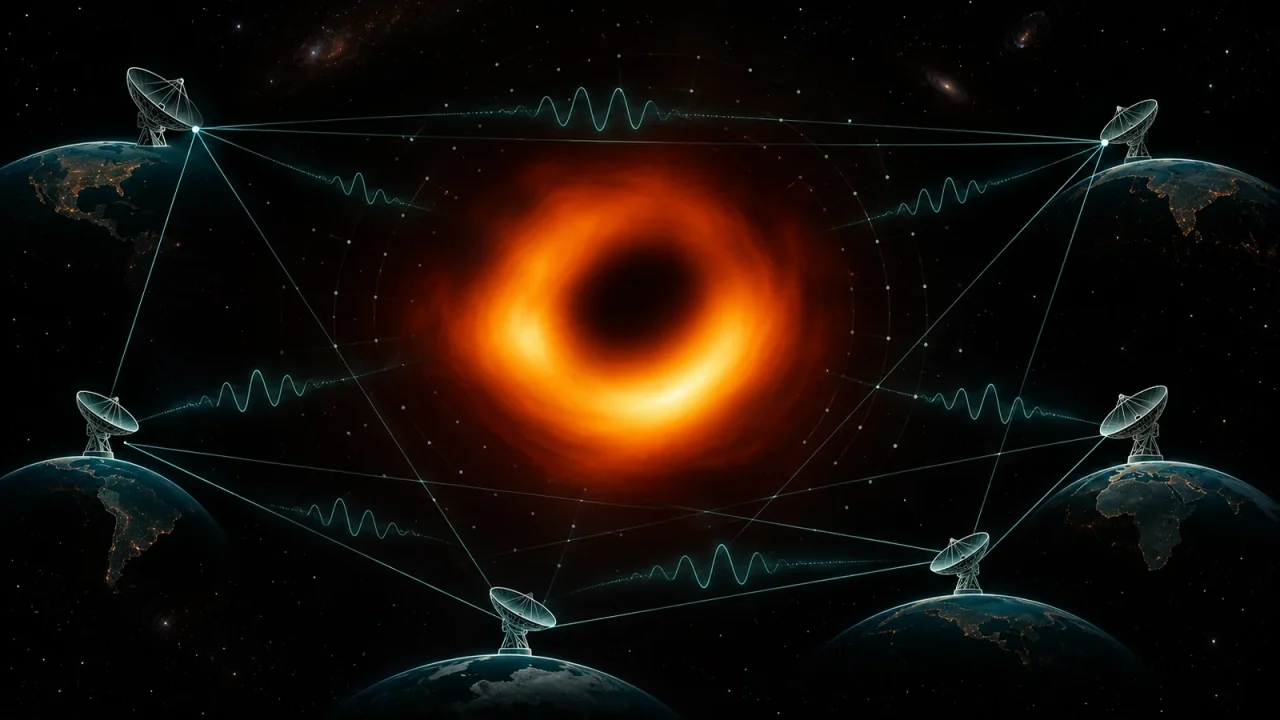
A four-person CSIRO team has independently reconstructed the ring around the supermassive black hole M87*, providing a new test of one of modern astronomy’s most recognisable images.
The result strengthens confidence that the broad ring seen by the Event Horizon Telescope is a genuine feature of the source rather than an artefact introduced by calibration or image-processing choices.
Why the original image needed another test
The Event Horizon Telescope combines measurements from radio observatories around the world to mimic an Earth-sized telescope. Because the measurements are sparse and each instrument is affected by calibration errors, turning them into an image is a difficult reconstruction problem.
Different assumptions and processing methods can produce different fine-scale structures. That has left room for debate about how strongly the data themselves require the famous ring-like morphology.
A reconstruction without a black-hole-shaped prior
The CSIRO researchers developed an approach called GenDIReCT. According to their peer-reviewed Nature paper, the method is built around interferometric observables that resist instrument-calibration errors and does not prescribe a ring shape in advance.
Applied to the M87* data, it recovered a ring with an angular diameter of 42.2 ± 1.5 microarcseconds. Under the scaling assumptions used in the paper, that corresponds to a black-hole mass of 6.5 ± 0.5 billion times the mass of the Sun.
CSIRO says the method combines telescope measurements in triplets rather than relying only on conventional pairs, while machine-learning techniques help reconstruct the source from the available information.
What has been confirmed
The independent result supports the broad ring morphology and its measured scale. That is important because the reconstruction was produced by a small team using an approach separate from the original Event Horizon Telescope imaging pipeline.
It does not mean every detail in every published M87* image is settled. Sparse interferometric data remain difficult to reconstruct, and fine-scale features can still depend on observations, algorithms and assumptions.
An Australian contribution with wider potential
CSIRO researchers say the mathematical techniques could have applications beyond astronomy wherever instruments must reconstruct images from incomplete or imperfect measurements. Medical imaging and earthquake mapping have been identified as possibilities, but those uses have not been demonstrated by this paper.
The work joins other Australian efforts to turn complex sensing data into useful information, including CSIRO’s continent-wide hyperspectral mineral mapping program.
Primary sources