

Monash mouse study separates organ ageing from immune ageing
A Monash-led mouse study found lifelong granzyme K deficiency reduced age-related organ damage without preventing immune ageing. Human effects remain unknown.
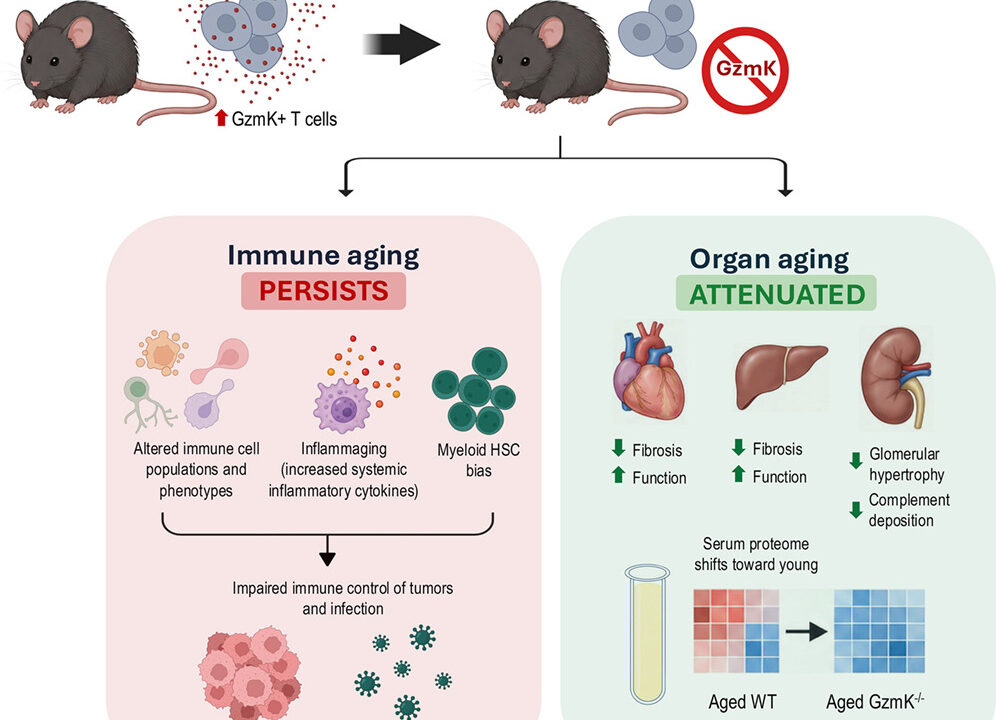
Australian researchers have identified granzyme K as a driver of age-related damage in several organs in mice, while finding that the animals’ immune systems continued to show the usual signs of ageing.
The result, published online in the peer-reviewed journal Immunity on 12 November, does not amount to a treatment for people. The experiments used mice that had lacked granzyme K throughout their lives. The researchers have not yet shown that blocking the protein later in life can reverse or prevent similar damage, or that the same effects occur in humans.
Even with those limits, the work is useful because it separates two processes that are often discussed together: the ageing of immune function and the decline of tissues and organs.
What the researchers tested
Granzyme K, usually shortened to GzmK, is a protein-cutting enzyme produced by immune cells. Its levels rise in ageing memory CD8 T cells, and earlier research has linked it to inflammatory pathways, including activation of the complement system.
The Monash University-led team compared young and old mice that could produce GzmK with mice engineered not to produce it. According to the research article in Immunity, the absence of the protein did not prevent the major features of immune ageing. T-cell dysfunction and other age-associated immune changes remained.
The organs told a different story. Older mice without GzmK showed less age-related decline across the heart, liver and kidneys. In the kidney, the change was associated with lower complement deposition and less enlargement of the filtering structures known as glomeruli. In the liver, the researchers reported less fibrosis and better function alongside higher decorin levels and reduced pro-fibrotic TGF-beta signalling.
Monash University’s account of the study also reports improved heart function and reduced fibrosis in the knockout mice.
The journal article describes the effect as tissue-specific. That is an important qualification: the results do not show that GzmK is a single master switch for ageing, nor that removing it improved every measure in every organ.
Why the distinction matters
Ageing is accompanied by both declining immune performance and chronic low-grade inflammation, sometimes called inflammaging. These processes are associated with organ damage, but association alone does not establish which pathways are driving which outcomes.
In this experiment, organ protection occurred even though immune ageing persisted. That suggests at least some tissue decline can be uncoupled from the broader deterioration of immune function.
The study also points to different mechanisms in different organs. Complement deposition was linked to the kidney findings, while the liver changes appeared to involve decorin and TGF-beta signalling instead. Any future therapy would therefore need to account for where and how GzmK is acting, rather than treating it as a uniform whole-body pathway.
The researchers examined human datasets as well and found elevated GzmK in people with several inflammatory and fibrotic conditions, including lupus nephritis and heart failure. Those observations do not demonstrate that GzmK caused the diseases or that a drug targeting it would help patients. They provide a reason to investigate the pathway further.
What remains unproven
The biggest translational gap is timing. Mice in the study were born without GzmK. A medicine would more realistically be given after ageing and tissue damage had already begun.
The Monash team says it is now investigating ways to block the protein selectively and test whether intervention later in life produces similar organ protection. Safety will matter too, because granzymes participate in immune biology and the consequences of long-term inhibition are not yet established.
For now, the evidence supports a narrower conclusion: lifelong GzmK deficiency reduced several markers of age-related organ damage in mice without preventing immune ageing. Whether that finding can become a safe treatment for people remains unknown.
More Australian research coverage is available in AUFront’s Technology & Science section.